Agile vs Scrum vs Waterfall: Which Methodology is Best?

The Importance of Development Methodology
When starting a software development project, choosing the right management methodology is just as critical as selecting the programming language or database architecture. The methodology defines how your team communicates, how requirements are captured, how risk is managed, and how progress is evaluated. The three most dominant methodologies in the software industry are Waterfall, Agile, and Scrum (which is a specific framework within Agile). Choosing the wrong model can lead to project delays, budget overruns, and misaligned deliverables.
Historically, software development followed rigid engineering processes derived from construction and manufacturing. Today, with rapid market changes and evolving user expectations, flexible approaches have become the standard. However, classic structured models still have valuable place in modern software engineering. Understanding the distinct differences between Waterfall, Agile, and Scrum allows you to choose the approach that matches your project scope, team size, and business goals.
Waterfall Methodology: The Structured Path
Waterfall is a linear, sequential development model where a project is divided into distinct, consecutive phases: Requirements, Design, Implementation (Coding), Verification (Testing), and Maintenance. In a pure Waterfall project, each phase must be fully completed and approved before the next phase can begin. There is no overlapping or backtracking without starting the project over.
Advantages of Waterfall
Waterfall provides high predictability and structure. Since requirements are fully documented at the start, clients receive clear budget and timeline estimates. The process is easy to understand, milestones are well-defined, and progress is simple to measure. Waterfall works exceptionally well for small, simple projects with stable requirements, and for highly regulated industries (defense, medical devices, aviation) where extensive upfront documentation and verification are legally required.
Disadvantages of Waterfall
The primary weakness of Waterfall is rigidity. Software projects routinely discover critical new information mid-development. In Waterfall, incorporating changes requires restarting the design phase, causing significant delays and costs. Furthermore, testing occurs only at the end of the development cycle. If a fundamental design flaw is discovered during the testing phase, fixing it is extremely expensive. Finally, clients do not see working software until the very end, introducing the risk that the delivered product does not match actual user needs.
Agile Methodology: The Flexible Philosophy
Agile is not a specific process or framework — it is a philosophy guided by the Agile Manifesto, published in 2001. The core principles of Agile prioritize individuals and interactions over processes and tools, working software over comprehensive documentation, customer collaboration over contract negotiation, and responding to change over following a plan.
Agile replaces Waterfall's linear phases with iterative cycles (typically 2-4 weeks long). The team develops a small, working slice of the software, gathers user feedback, adjusts requirements, and plans the next cycle. This continuous feedback loop ensures the product evolves in response to reality, minimizing the risk of building the wrong thing.
Scrum: The Agile Implementation
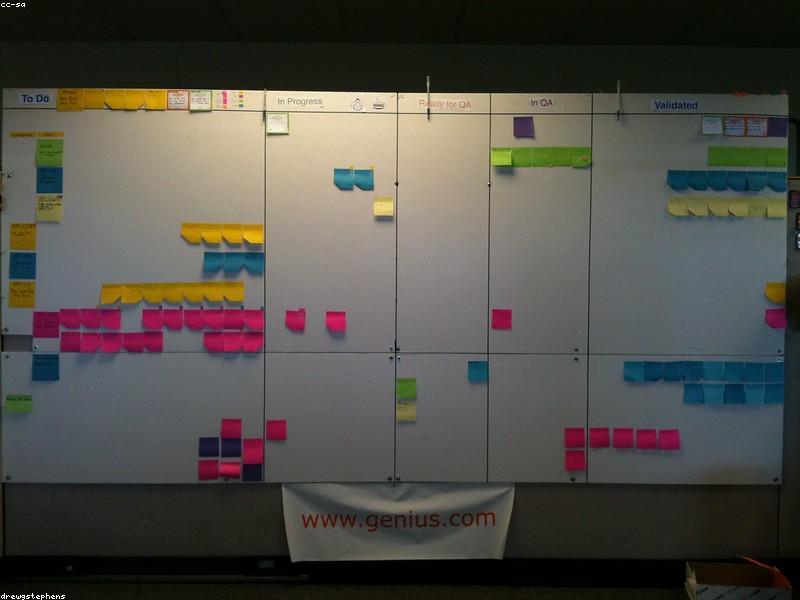
If Agile is the philosophy, Scrum is the specific, highly structured framework used to implement it. Scrum is the most popular Agile framework in the software industry, defining specific roles, ceremonies, and artifacts to guide the team:
- Roles: The Product Owner (manages the product backlog and represents user needs), the Scrum Master (facilitates the process and removes blockers), and the Development Team (cross-functional engineers who build the software).
- Ceremonies (Events): Sprint Planning (defining what to build next), Daily Scrum (15-minute sync on progress and blockers), Sprint Review (demoing working software to stakeholders), and Sprint Retrospective (analyzing how to improve team processes).
- Artifacts: Product Backlog (prioritized list of all features), Sprint Backlog (selected features for the current iteration), and Increment (the working software delivered at sprint end).
Side-by-Side Comparison
| Feature | Waterfall | Agile (General) | Scrum (Specific) |
|---|---|---|---|
| Approach | Linear, sequential | Iterative, flexible | Iterative sprints (1-4 weeks) |
| Requirements | Fully defined upfront | Evolving dynamically | Prioritized in backlog |
| Testing | At the end of development | Continuous throughout | Every sprint |
| Customer Involvement | High at start/end | Continuous throughout | At sprint review demos |
| Risk Profile | High (late validation) | Low (frequent iteration) | Low (predictable delivery) |
How to Choose the Best Model for Your Project
Choose Waterfall if: your requirements are fully documented, stable, and unlikely to change; you are building safety-critical or heavily regulated systems; your budget is fixed and scope is rigid; or your vendor relationship is built on a strict fixed-price contract with zero scope flexibility.
Choose Agile/Scrum if: you are building a new software product (SaaS, mobile app) where requirements will evolve through user feedback; your team is cross-functional and collaborative; you want to launch a Minimum Viable Product (MVP) quickly and iterate; or you are working with an offshore team under a Time and Materials contract where flexibility is a key driver.
Conclusion: Adapting to Project Realities
There is no single "best" methodology — the right choice depends on your project constraints, technology domain, and organizational culture. Startups and modern software companies lean heavily toward Scrum and Agile to maintain speed and flexibility. However, combining approaches is increasingly common: using Waterfall principles for budgeting and high-level architectural planning, followed by Scrum sprints for actual coding and delivery. Align your methodology with your business goals to ensure successful, on-time project delivery.
Frequently Asked Questions
Nikhil
Founder & CEO @ Gemora Tech
With extensive experience in enterprise software architecture, AI models, and immersive game development, Nikhil leads Gemora Tech in delivering scalable digital transformation solutions for clients worldwide.